
Lennart Brede
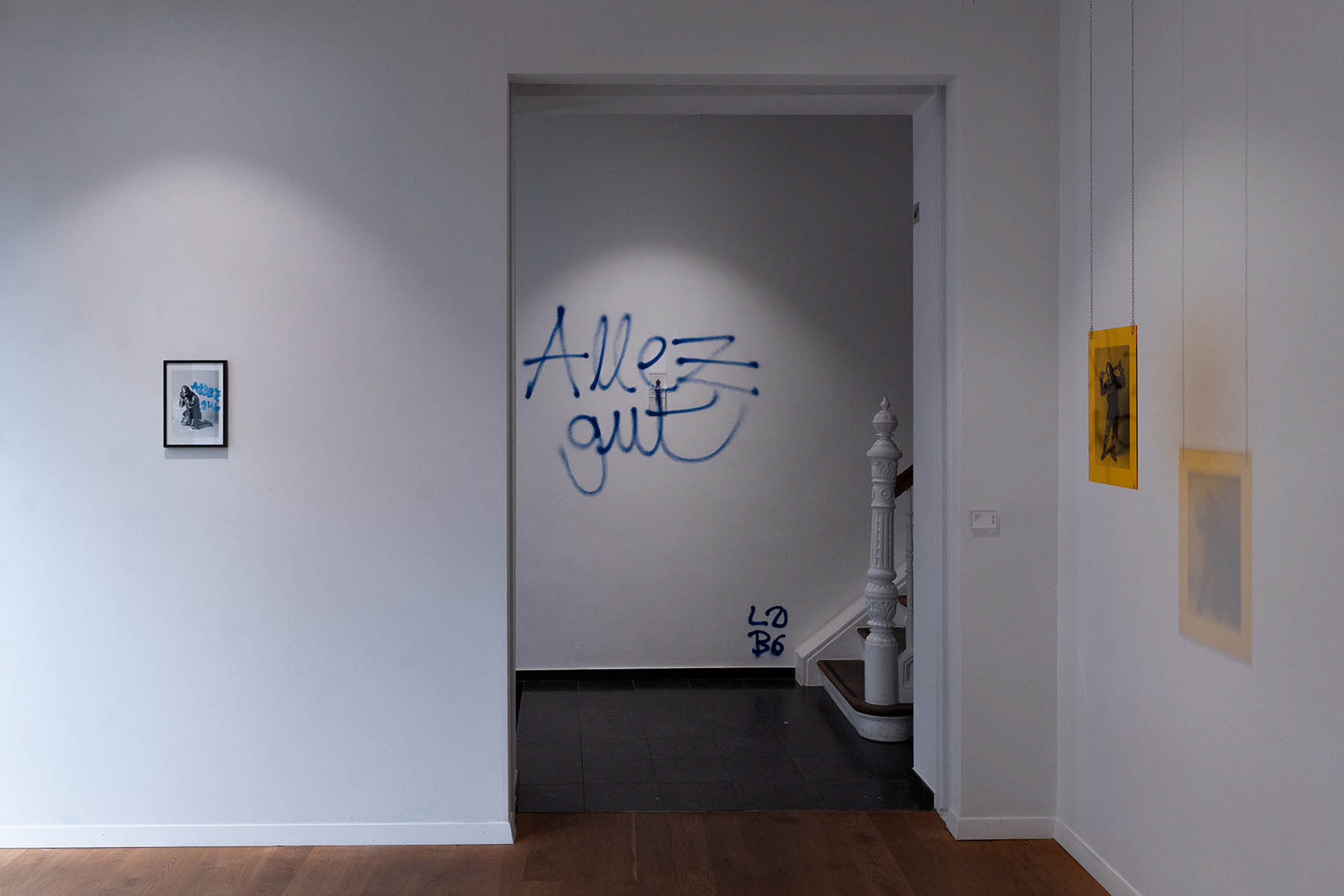
Allez Gut
Sep 4 – Oct 22, 2026
As part of DC Open, ANNA LAUDEL Düsseldorf presents ALLEZ GUT, a new solo exhibition by Berlin-based artist Lennart Brede. One of the Rhineland’s key art events, the annual gallery weekend marks the opening of the new exhibition season.
At first, the exhibition title reads like a casual, almost throwaway phrase. Yet ALLEZ GUT articulates a position between optimism and responsibility. At a time of growing uncertainty, it reflects a conscious decision not to abandon the belief in what is good. The exhibition begins precisely where familiar certainties start to lose their hold.
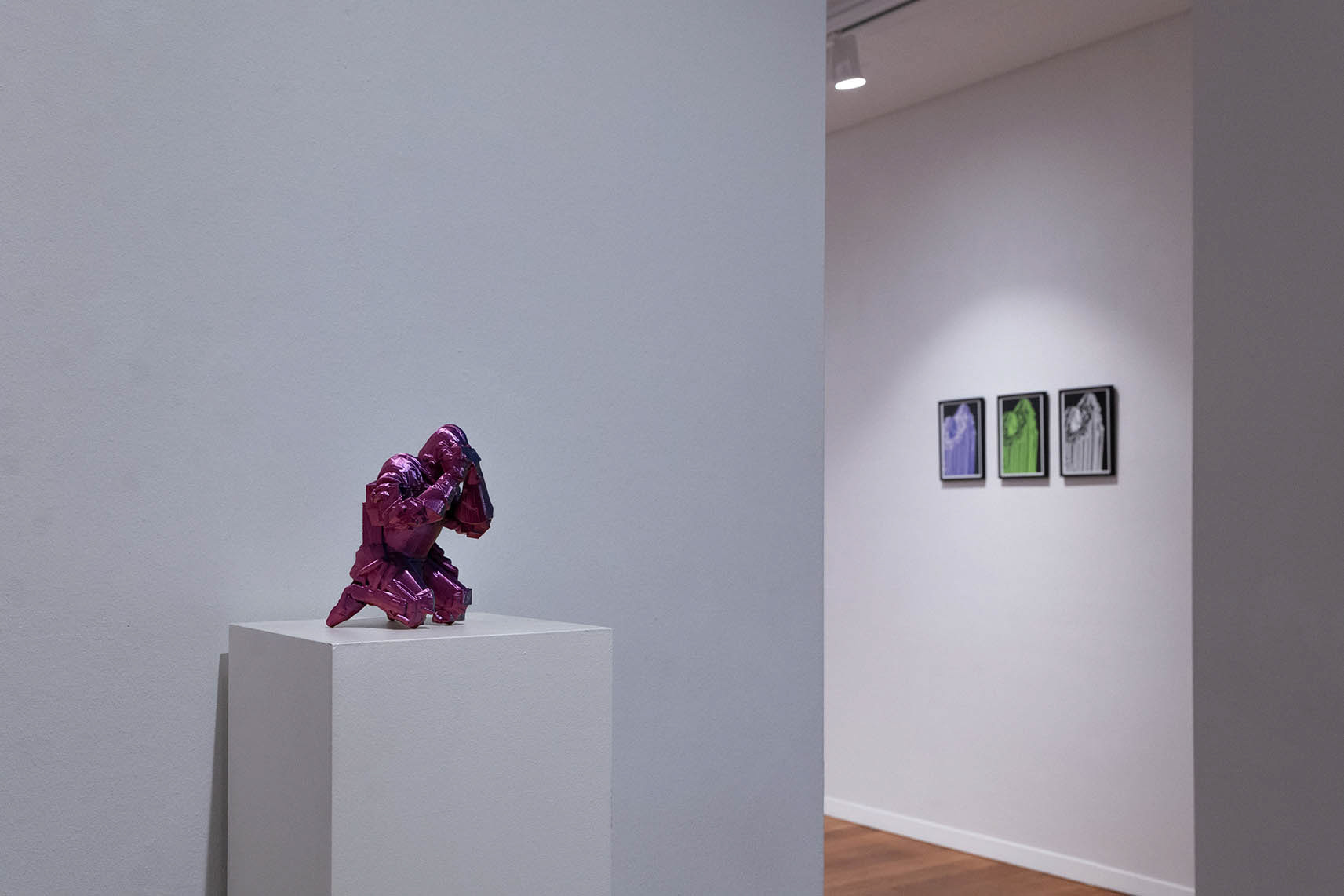
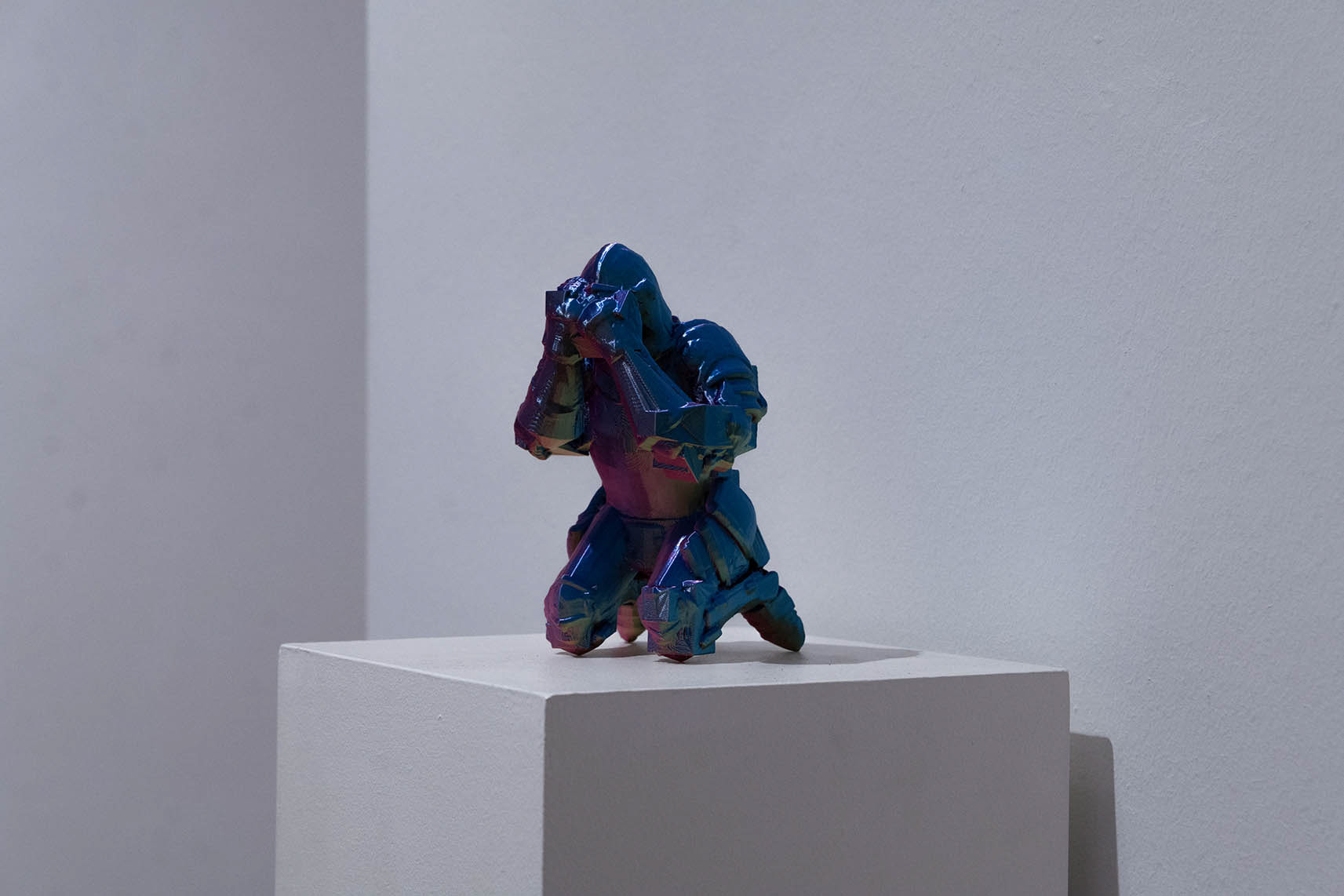
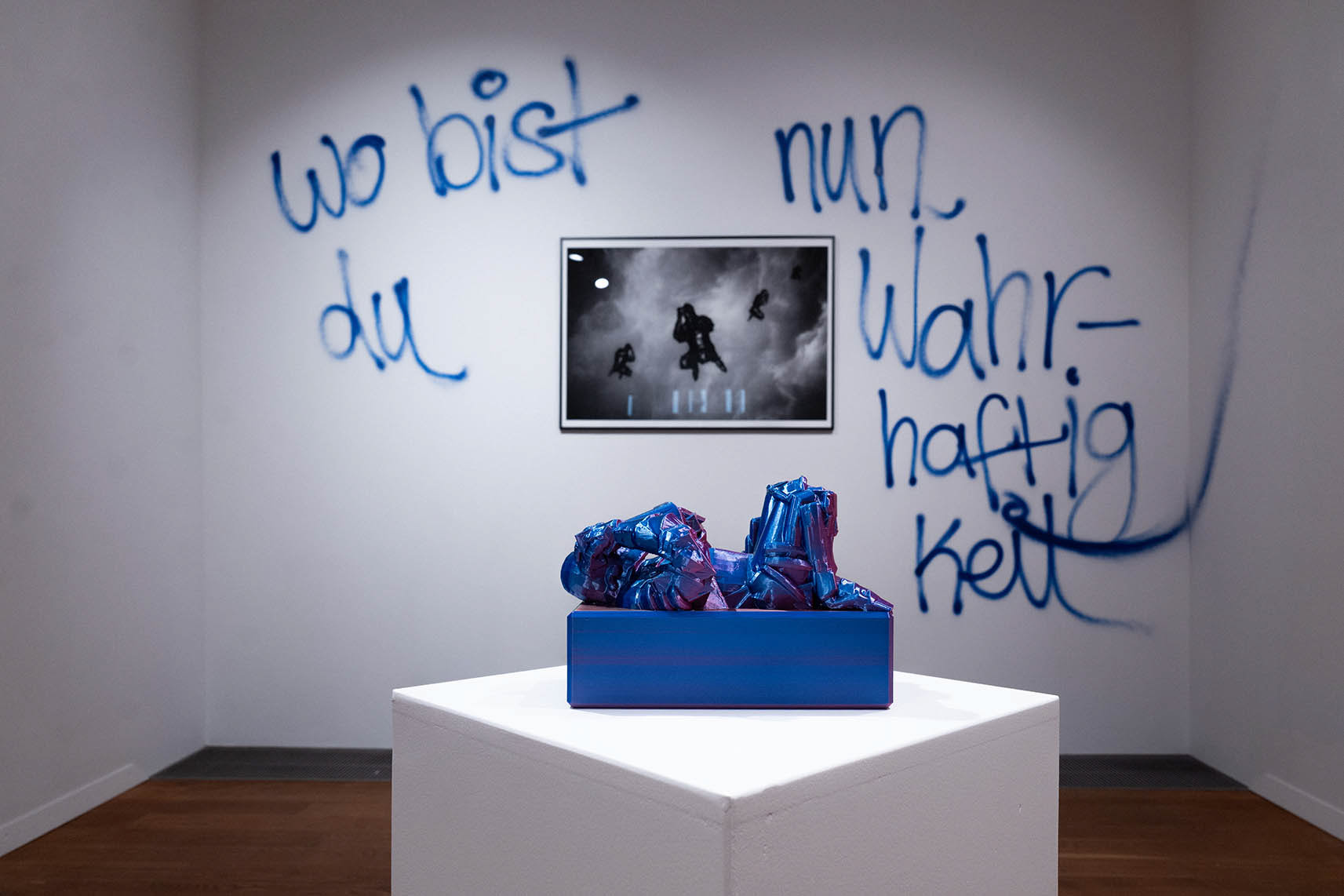
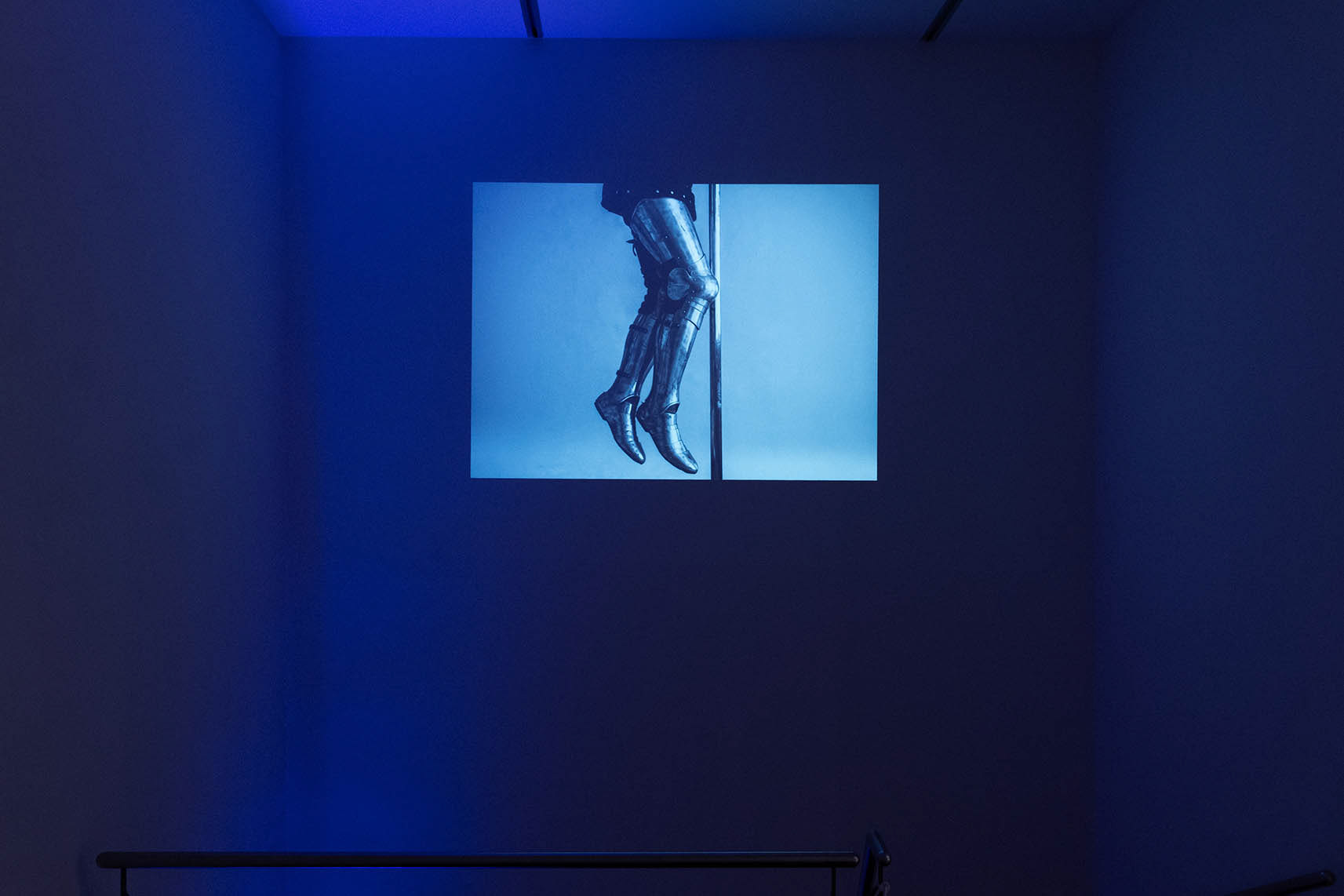
At its centre is the Broken Knight of Abendland. Deeply rooted in European cultural history, the figure of the knight appears here neither as warrior nor victor, but in a moment of vulnerability. Kneeling with his face buried in his hands, his armour is fractured by geometric forms that seem to both disrupt and hold it together. Suspended between strength and exhaustion, protection and exposure, the knight becomes an image of a present in which established certainties are beginning to fracture, while the need for orientation and connection remains.
For Brede, the knight embodies a contemporary hero’s journey. The decisive moment is not one of triumph, but the point at which the armour can no longer be worn. It is only through this moment of exposure that another kind of encounter becomes possible — with oneself, with others, and with one’s own history.
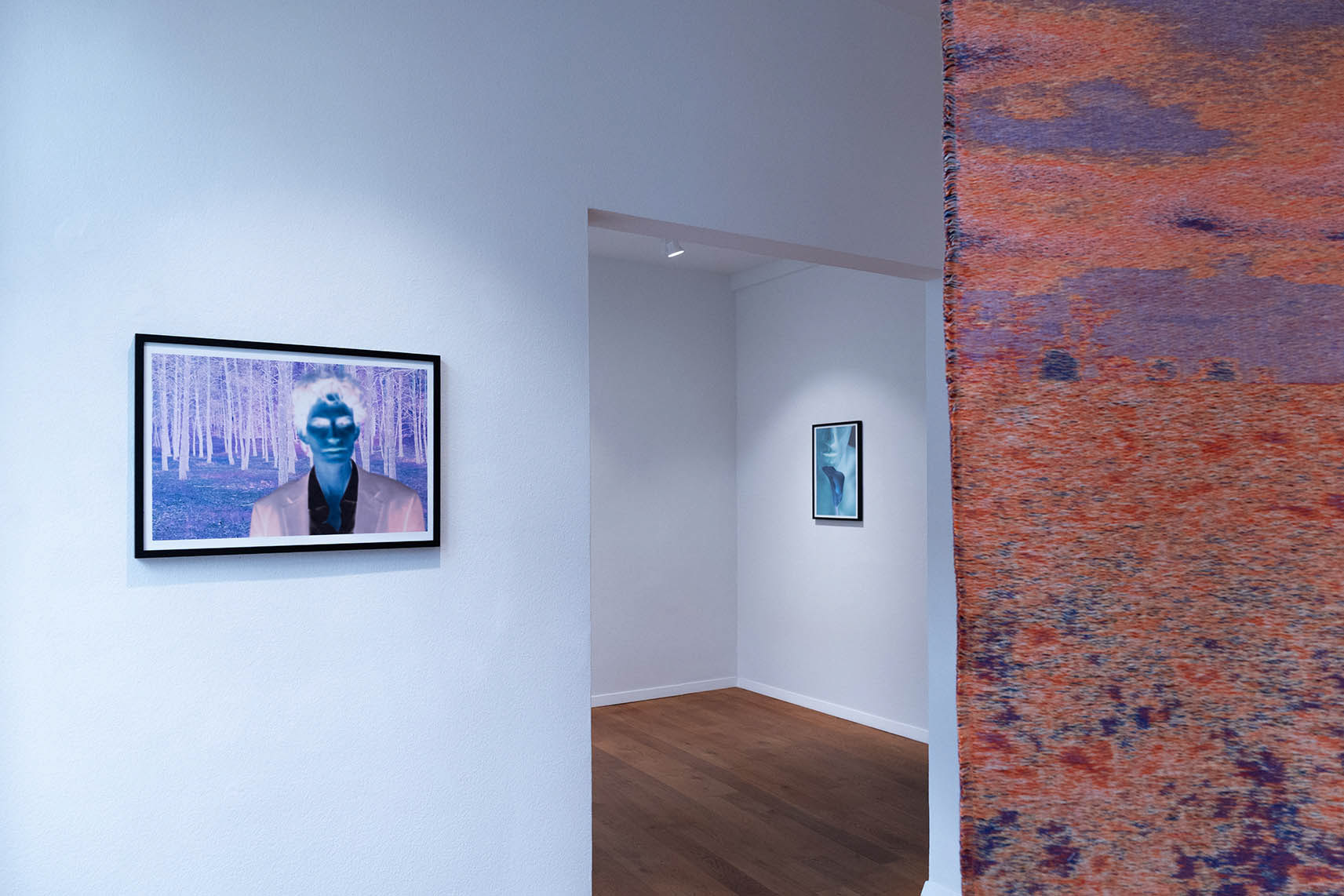
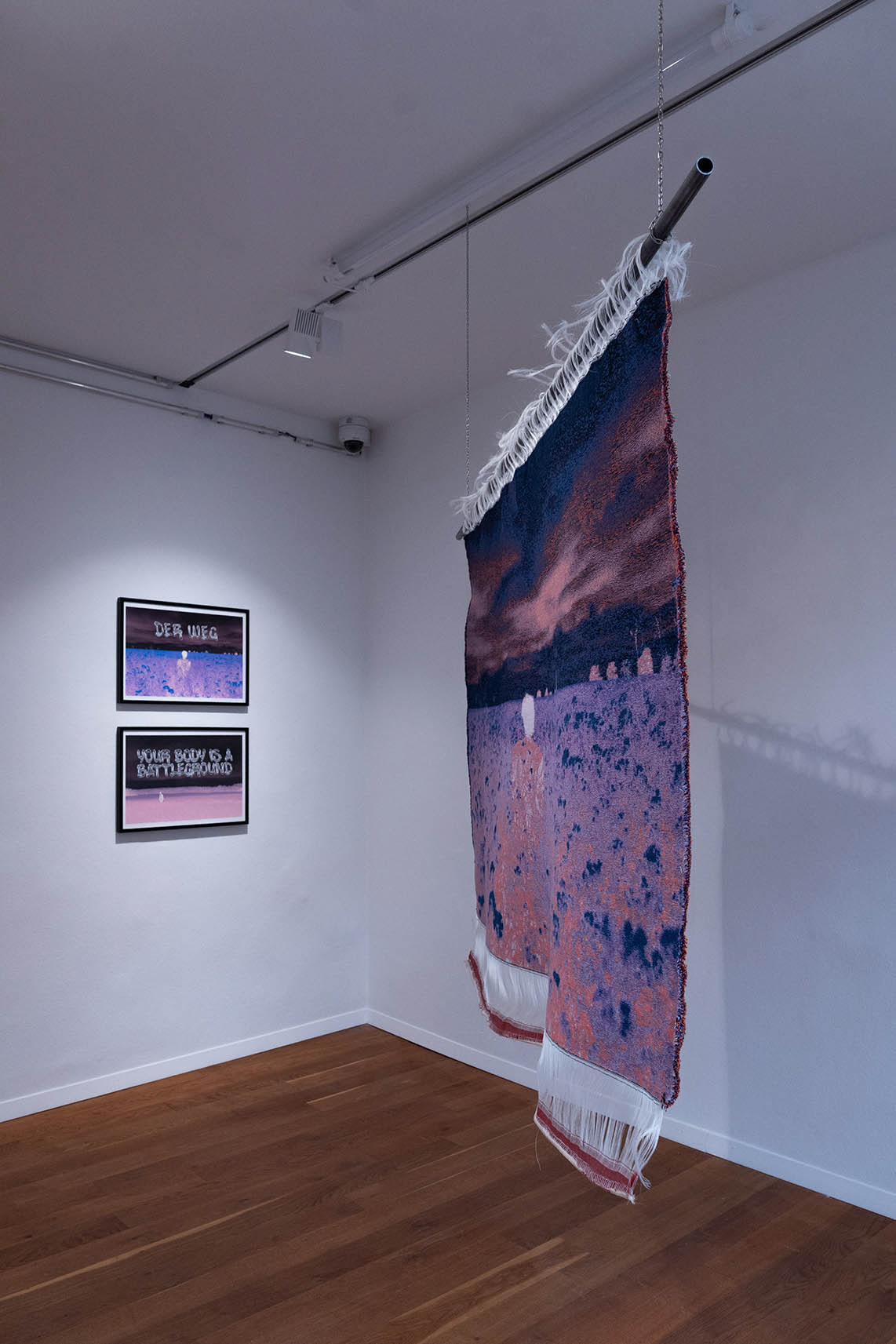
This transformation continues across the exhibition’s other bodies of work. Photographs move beyond the flatness of the image, reappearing as tapestries, works in glass, and sculptural objects. Floral motifs recur throughout and are closely tied to Brede’s own biography. Growing up in a family of florists, he approaches flowers not as decoration, but as witnesses and companions to fundamental human experiences — love, loss, farewell, and new beginnings.
ALLEZ GUT is ultimately a call to move forward. It asks what kind of position we might take in the face of uncertainty and change. Rather than offering simple answers, the works suggest that responsibility may begin precisely at the point where we become willing to question what we once took for granted.
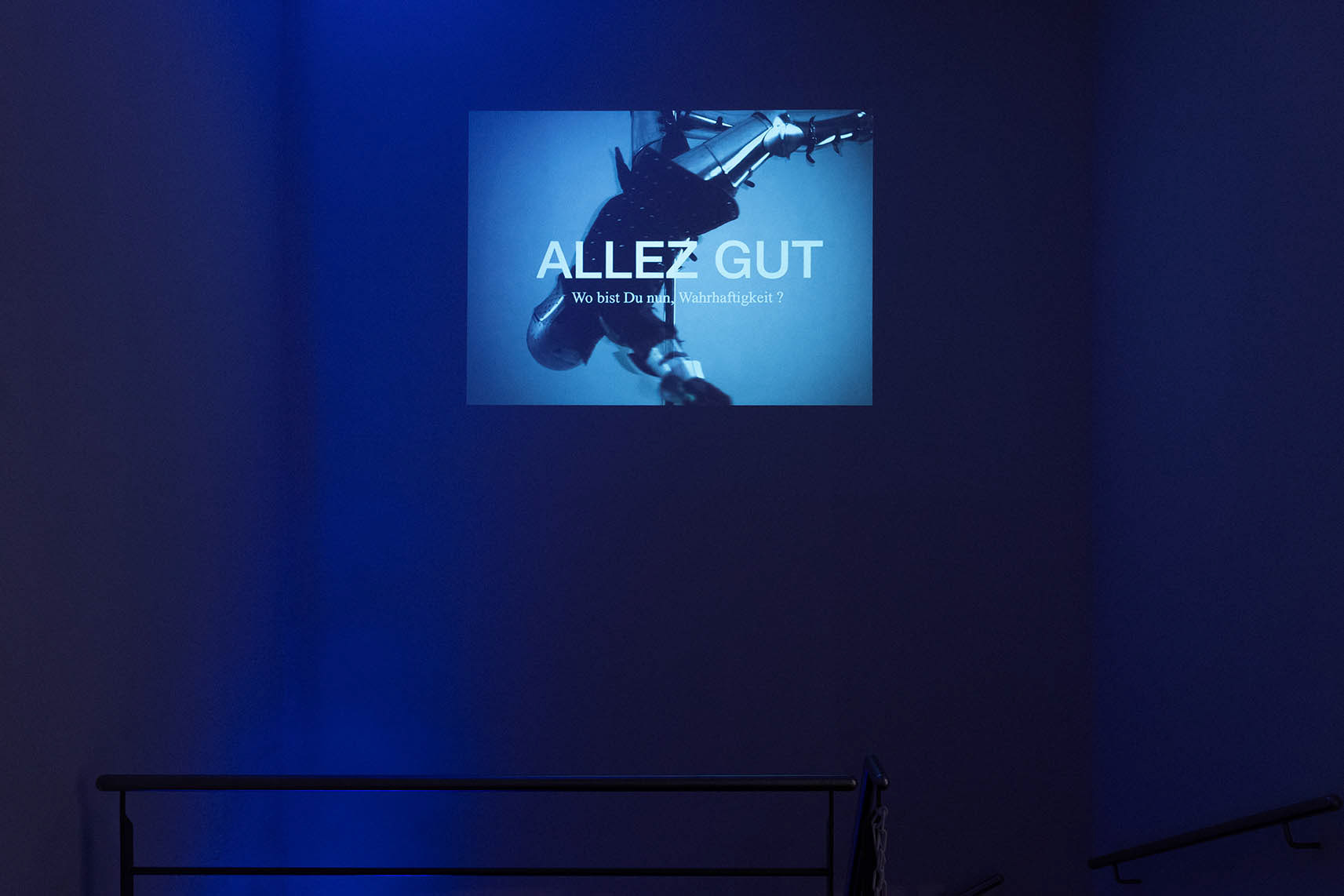
ALLEZ GUT
Where are you now, truthfulness?
Exhibition Work Information / Curatorial Dossier
ARTIST STATEMENT
There are images that create an era. And there are images that reveal when an era is coming to an end. The works in “ALLEZ GUT” move precisely within this in-between space. They do not tell of the downfall of a world, but of a moment in which familiar certainties lose their self-evidence. The old is still present, the new can already be sensed, but is not yet fully visible.
Above the exhibition stands the question “Where are you now, truthfulness?”. Not because truth has disappeared, but because today it is increasingly asserted, staged and instrumentalized. Ideologies, religions, political systems, media and algorithms produce their own realities. Truthfulness, by contrast, is harder to possess. Perhaps it can only be lived.
At first, “ALLEZ GUT” sounds almost casual, like a slightly displaced everyday phrase, half confidence, half self-reassurance. This is precisely where the title’s double meaning lies. It is an ironic comment on a present in which obviously not everything is good, and at the same time an attempt not to give up belief in the good too quickly. Less a statement than an invocation.
At the center of the exhibition, initially, stands the knight. My turn toward this figure is rooted in both biography and art history. Growing up in a landscape between the Rhine and the Moselle, shaped by castles, ruins and the visible remnants of medieval history, I encountered the knight long before he became part of my artistic language. At the same time, he is one of the great projection figures of European cultural memory. Images of knights carry ideas of courage, protection, honor, faith, defensibility and masculine strength, but equally the history of crusades, expansion, conquest and power. The knight is therefore never merely a historical figure. Within him, narratives condense about how Europe has seen and represented itself.
In “ALLEZ GUT”, this figure begins to lose its closed form. The knight kneels, hides his face, lies on the ground. His armor dissolves into fragments. The shell that promises protection and invulnerability cannot save what is inside. What breaks, then, is not only a figure, but also the idea of invulnerability.
The rupture, however, is not the end of the movement. I am interested in what happens after the moment when armor no longer functions. Armor becomes body, metal becomes flowers, monuments become personal memories. Photography leaves paper and becomes glass, textile or sculpture. Material is not merely the carrier of an image; it participates in the narrative. Glass is hard and at the same time fragile. Textiles consist of countless individual threads.
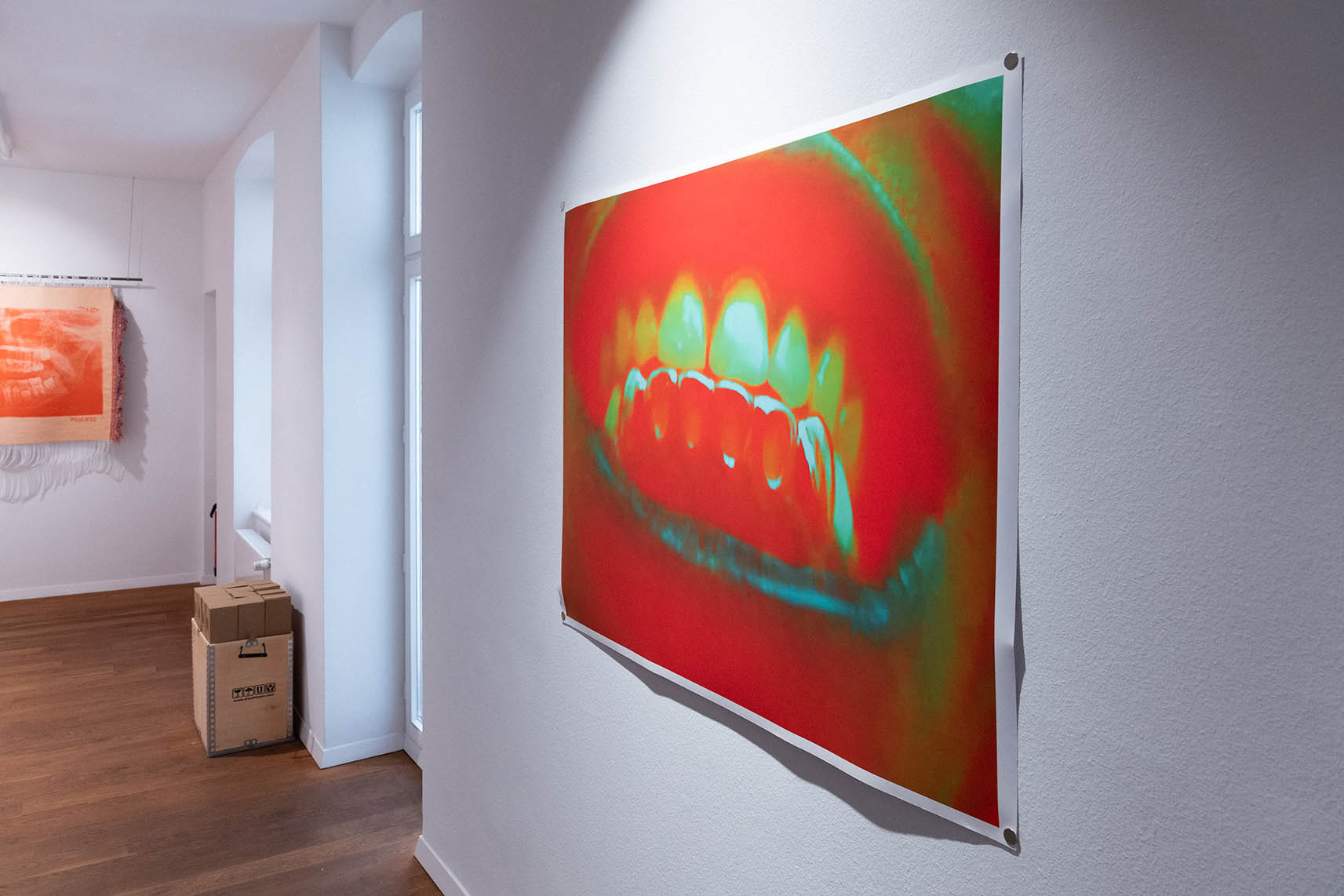
Plants live and die. A body loses teeth and forms new ones. Transformation does not take place only as a theme; it inscribes itself into the materials.
The flowers, too, lead back into a personal history. I come from a family of florists. Flowers were never simply decoration there. They accompany birthdays and weddings, love and apology, illness, farewell and death. Hardly any other object appears so naturally at the transitions of a human life. Perhaps their strength lies precisely in the fact that they promise no permanence. They bloom and they fade. In this way, the flower responds to the knight, not as his opposite, but as another idea of strength. Where armor attempts to exclude vulnerability, the flower exists precisely through its fragility.
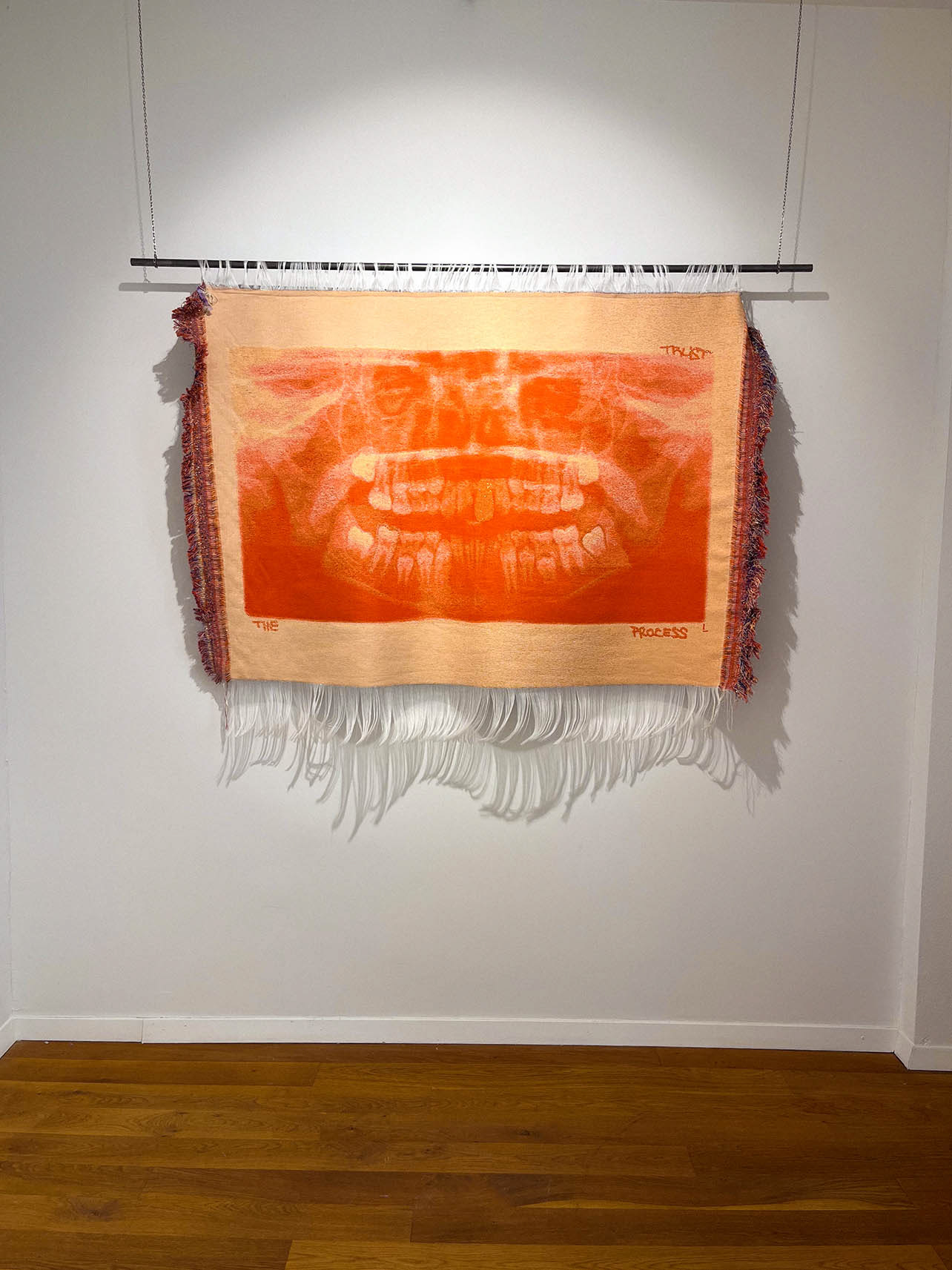
From there, the exhibition moves on to the human body and finally to process itself. “TRUST THE PROCESS” begins with an X-ray image of a child’s teeth. The baby teeth are still present while the permanent teeth are already growing behind them. An astonishing image: the old has not yet disappeared while the new is already claiming its place. Development cannot be forced. It can be accompanied, but never fully controlled.
Perhaps this is precisely the movement that “ALLEZ GUT” describes. It can be read as a contemporary form of the hero’s journey, though without a classical hero and without victory. The movement leads from armor through rupture to the body, from there to the flower and to process, and finally to the question of decision and path. The decisive moment is not triumph. Perhaps it is the moment when the hero removes his armor. Only there does the possibility of a genuine encounter arise: with others, with history and with oneself.
“ALLEZ GUT” is therefore not an exhibition about decline. It is about the possibility of moving forward. Not as naive optimism, nor as pessimism, but as a question of responsibility. What attitude do we need in order to shape, with truthfulness, the world we leave to our children? The works do not provide an unequivocal answer. But they suggest a direction.
BROKEN KNIGHT OF ABENDLAND 00
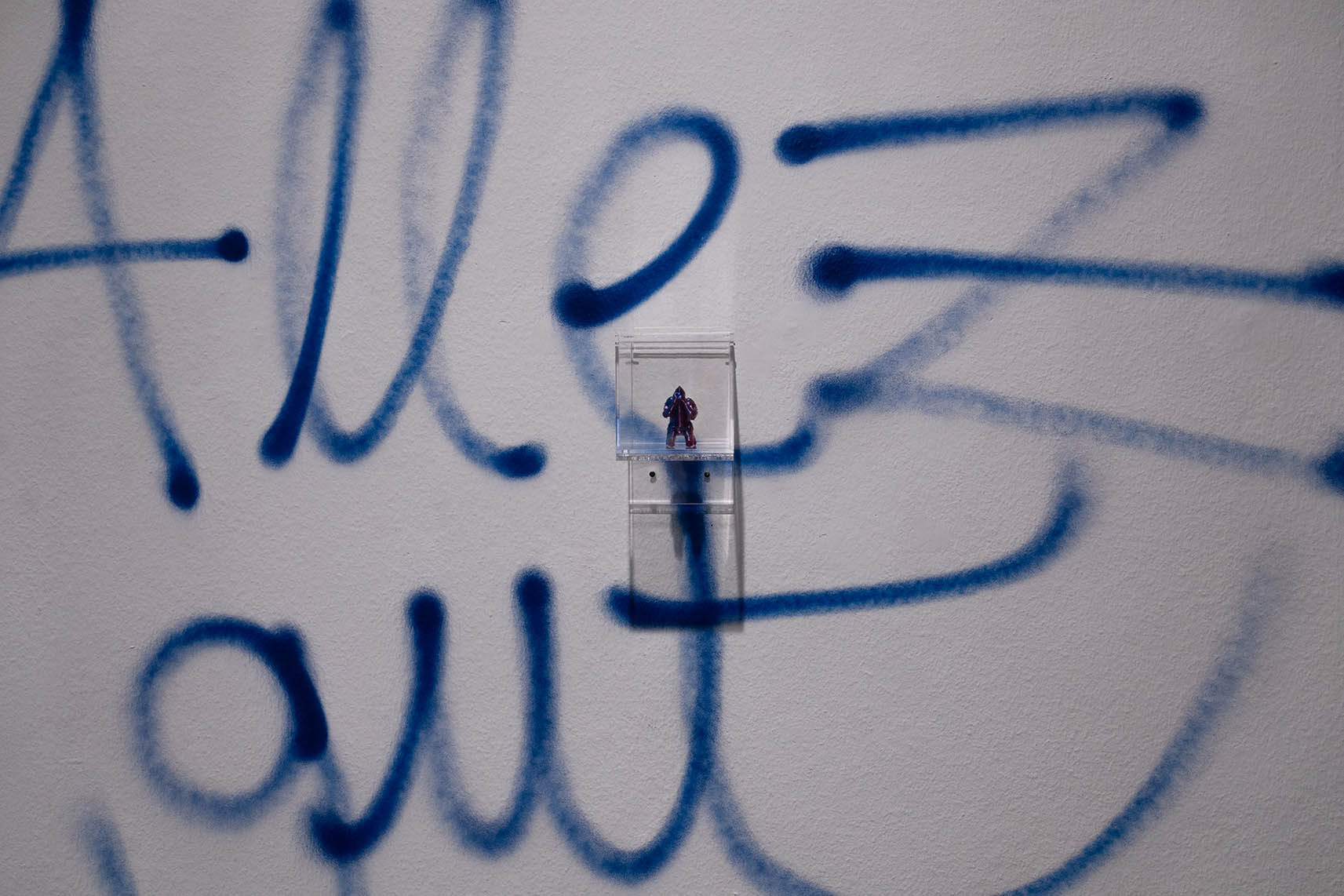
“Broken Knight of Abendland 00” marks the beginning of the sculptural development of the knight figure. Even before the Knight becomes a clearly defined body of work, a first physical manifestation of the motif appears here. In contrast to the later works, the form is still rounder, softer and less geometrically organized. The armor does not appear constructed, but almost partially melted. Body and armor merge into one another, as though the figure had been subjected to a process of heat, pressure or deformation.
This is precisely what gives “00” its particular position within the series. The rupture has not yet been clearly articulated here. Instead, the figure exists in an intermediate state, as though it were only gradually finding its later form. It is not merely a preliminary stage in a technical sense; it makes the process of becoming itself visible.
In the installation, the small figure appears inside a transparent display case. Its physical presence is thereby both emphasized and removed. It seems protected, preserved, almost like an archaeological object or relic, even though it already embodies the image of a deformed protective figure. The armor is still soft. The rupture is only beginning.
BROKEN KNIGHT OF ABENDLAND 01
The title “Broken Knight of Abendland” places two linguistic spaces against and within one another: English and German, global legibility and cultural localization. The broken knight, once an emblem of strength, protection and order, appears at a moment of radical vulnerability.
The figure kneels and covers its face with its hands. The gesture remains open. It can signify protection, shame, despair or overwhelm, perhaps also silent weeping. The knight has not fallen in battle. His rupture seems to come from within.
Formally, the sculpture moves between figuration and dissolution. Classical elements of armor remain recognizable, while at the same time the body disintegrates into geometric and cubic structures. Paradoxically, these very fragments appear to be what holds the figure together at all. Stability and disintegration exist simultaneously.
As a “Knight of the Occident”, the figure carries a historical dimension beyond its personal condition. It refers to Western self-images of strength, progress, protection and moral authority, and to their contradictions. Crusades, expansion and economic interests stand alongside narratives of freedom, Enlightenment and democracy. The work does not formulate an unequivocal accusation from this. Instead, it asks what happens when the images through which a culture has described itself for a long time lose their self-evidence.
The knight remains. But his posture has changed.
BROKEN KNIGHT OF ABENDLAND 02
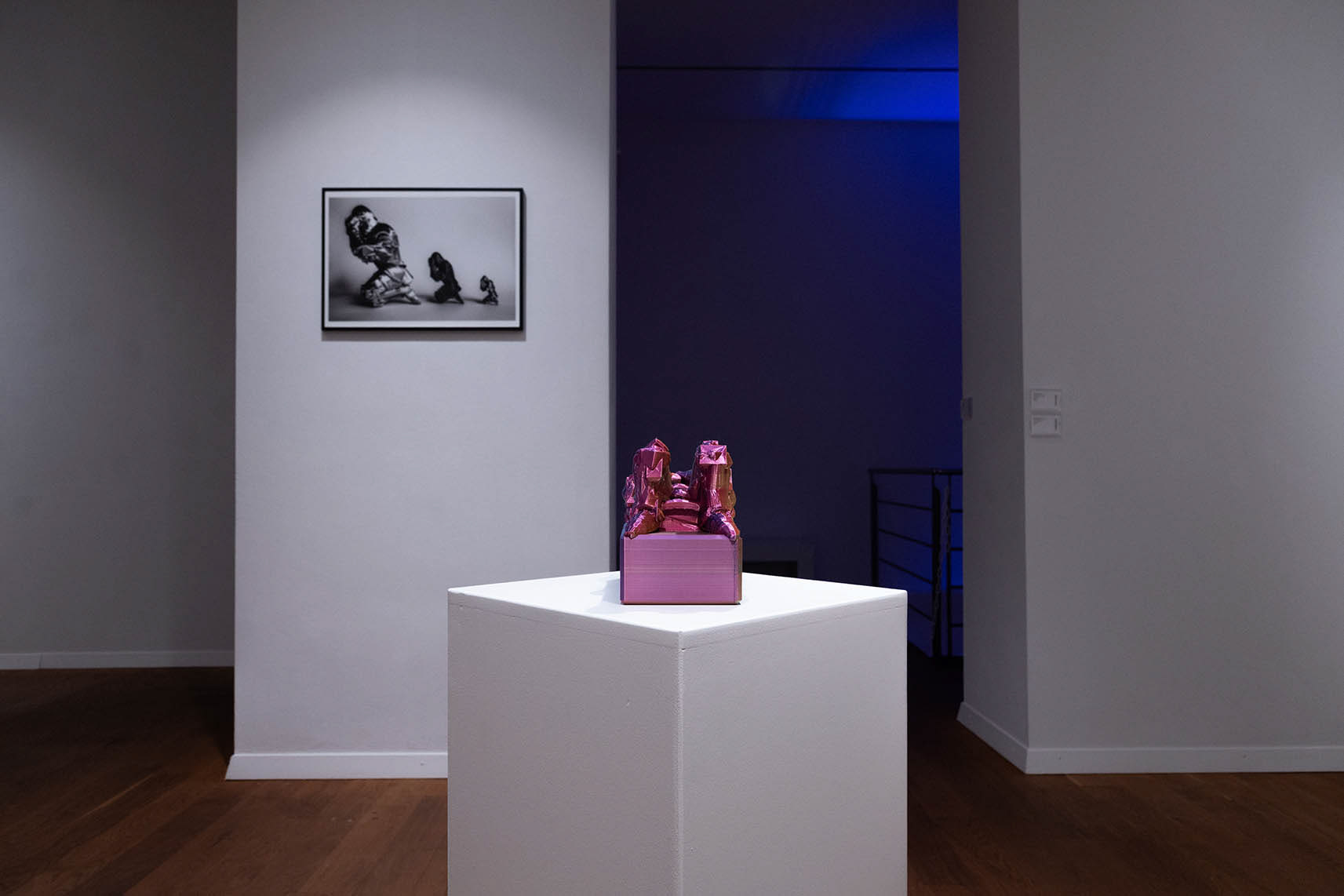
“Broken Knight of Abendland 02” continues this movement. While “01” is still kneeling, the body has now moved completely into the horizontal. The knight lies down. Whether he is sleeping, fallen or already dead remains open.
The work takes medieval effigies and transi tombs as its point of departure. While effigies often portray the deceased in an idealized, dignified and seemingly intact state, transi representations confront us with the physical reality of death. Behind the representative image appears the mortal body. The memento mori becomes a reminder that even the most closed surface has an end.
Armor is particularly suited to this idea. It is a hard shell around a soft body, metal around flesh, an object whose purpose is to ward off injury and death and which nevertheless cannot alter the fact that the body beneath it ages, is wounded and decays. Hard shell, soft and ultimately rotting core.
Formally, too, decay has reached the surface. Armor and body can no longer be completely separated; geometric fragments hold the figure together and dissolve it at the same time.
This shifts the meaning of brokenness in relation to “01”. There it can be read psychologically and socially; here it becomes physical and existential. Kneeling becomes lying down. Crisis becomes finitude.
Yet medieval tomb figures do not speak only of death, but also of the transition between physical existence and memory, presence and absence, what passes away and what remains. “Broken Knight of Abendland 02” therefore does not remain merely a figure of death either. The armor may outlast the body. But it cannot save it.
KNIGHT SERIES
Photography, Fine Art Print, Acrylic Glass
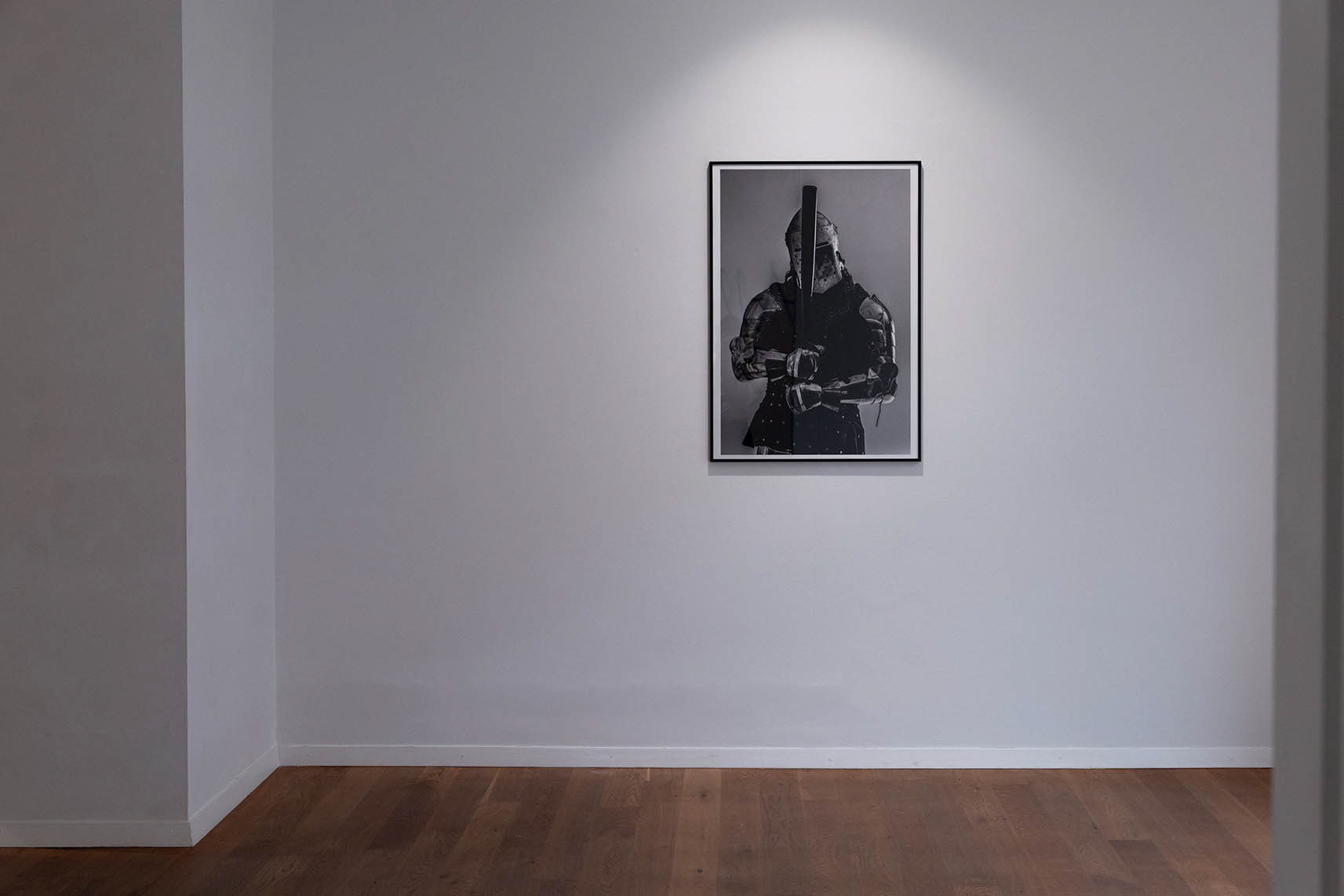
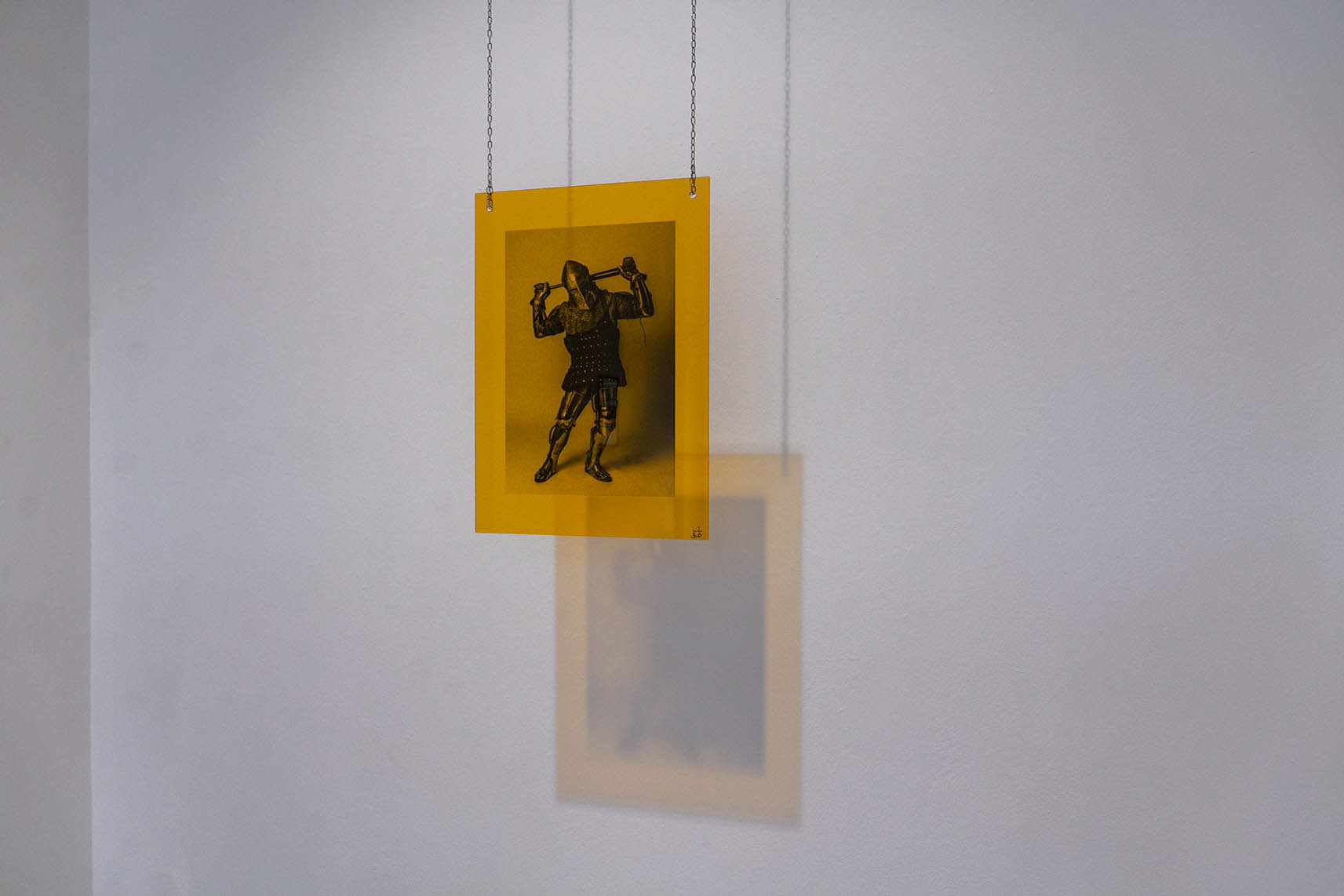
The photographic “Knight Series” expands the knight figure through a play with posture, staging and contemporary codes. I am interested in oppositions such as masculinity and femininity, hardness and softness, conquering and allowing, defense and opening.
This exploration already began in the earlier body of work “Du Musst Jetzt Dolle Stark Sein”, for which I worked with a female bodybuilder. There, too, a body stood at the center, visibly producing strength and at the same time exposing the expectations attached to this image of strength. For the “Knight Series”, I collaborated with the rapper Grim104. Parts of it later became the cover artwork for his album “No Country for Old Grim” on Buback.
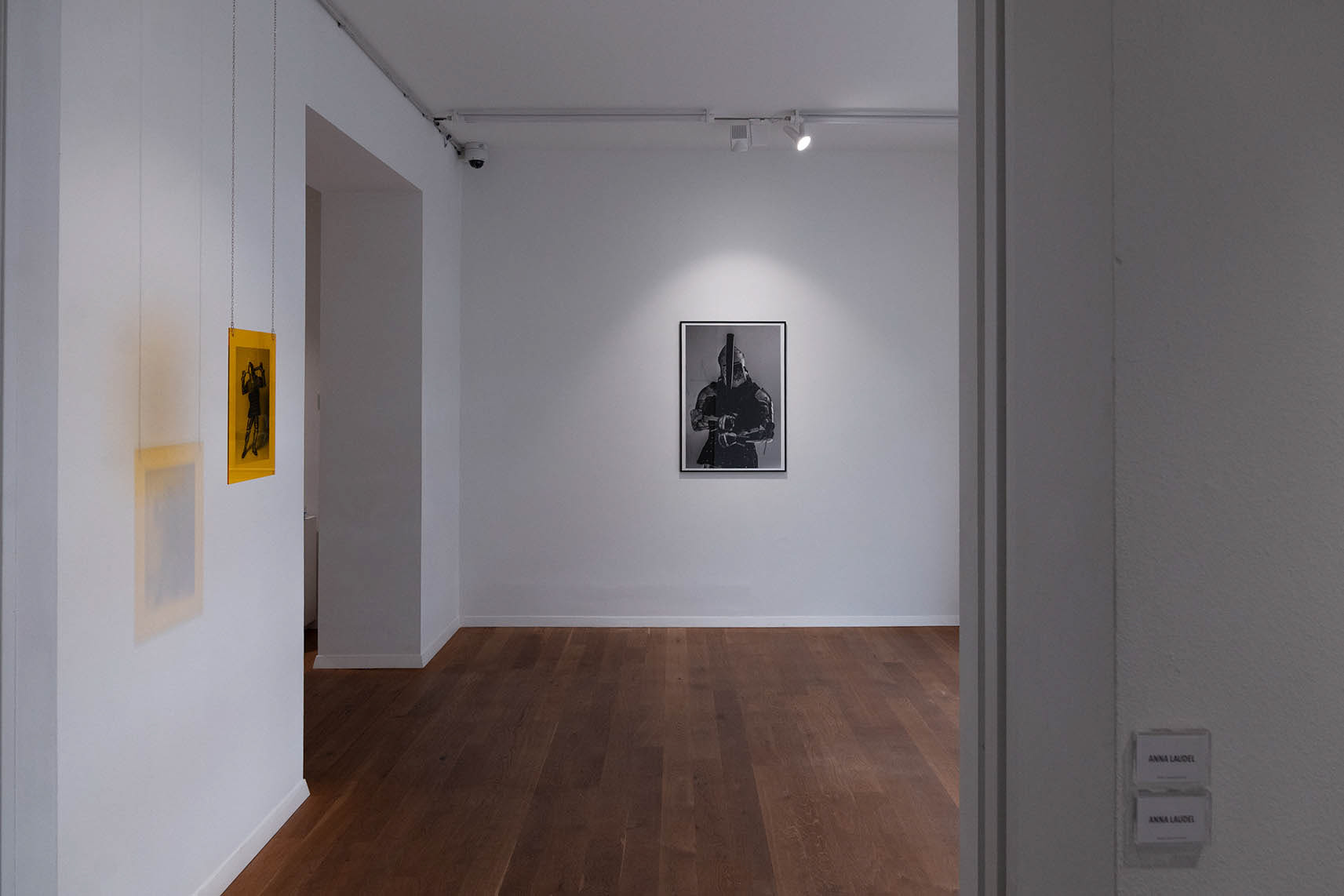
Within the series, the knight constantly changes role. In “DON’T CARE KNIGHT”, the baseball bat rests casually behind his shoulders. The pose feels cheeky, confrontational and almost youthful, with an undertone reminiscent of the ritualized violence of “A Clockwork Orange”. In “NEVER SURRENDER KNIGHT”, by contrast, the figure kneels with raised arms. Surrender or triumph, submission or resistance: the title asserts not giving up, while the posture may tell a different story.
“NIGHTY KNIGHT” shows the knight frontally. The baseball bat stands vertically in front of the visor and, through its strict centrality, becomes almost an iconic object. Weapon, cross, insignia or shield can no longer be clearly separated from one another. The historical knight figure encounters the gestures and visual codes of the present and thereby loses its unequivocal role.
THE RECKONING ABOVE
“The Reckoning Above” shows four “Broken Knights of Abendland” floating through a cloud-covered sky. Their heavy, armored bodies are paradoxically suspended in a state of weightlessness. What should be bound to material, earth and weight has left the ground.
The composition deliberately draws on the dramatic staging of classical European painting. Light, clouds and bodies recall Baroque religious and mythological imagery and the dramatic use of light associated with Rembrandt. Yet in place of angels, saints or the redeemed appear broken knights.
What happens to them remains unclear. The scene may evoke ascension, redemption or reckoning, but just as easily a moment immediately before the fall. The title deliberately keeps this suspension open. “Reckoning” can mean a settling of accounts as much as realization, or the moment when taking stock becomes unavoidable. The sky need not be the place of redemption. Perhaps it is the place of reckoning.
GENERATIONS
“Generations” shows three knight sculptures whose physique and materiality change and seem to intensify from figure to figure. The sequence vaguely recalls the familiar evolutionary image from ape to upright human, except that here it is not the human being that seems to evolve, but his armor. Almost like a galactic-futuristic version of evolution.
The work therefore asks what we actually call progress. Does the body become stronger, or merely its shell more complicated? The three figures can be read as generations that inherit, alter and carry forward the constructions of their predecessors. Progress appears less as linear improvement than as an accumulation of material, technology, experience and protective mechanisms. Beneath all these layers, however, the same vulnerable body remains imaginable.
MONOLITH KNIGHT No. 01–03
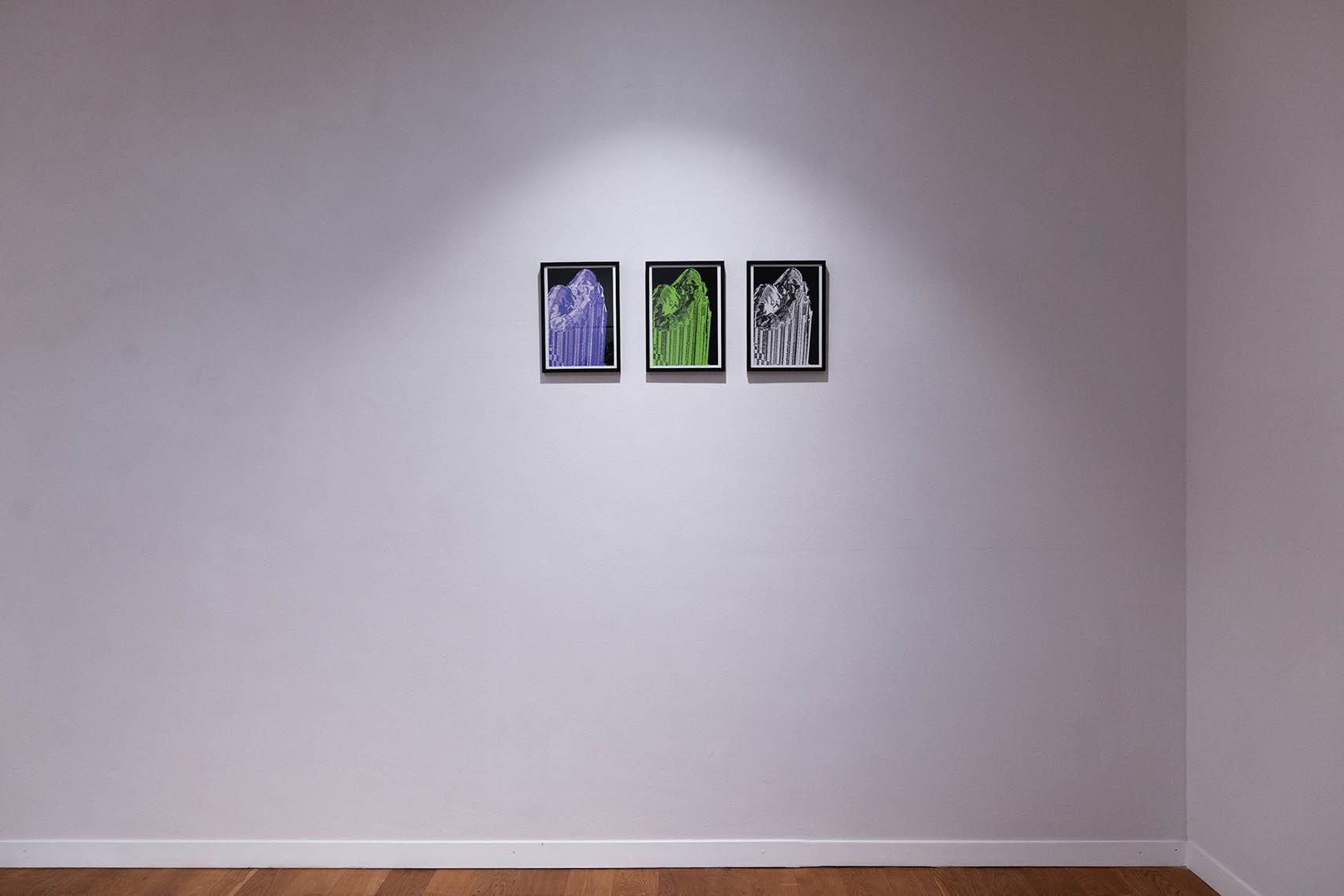
“Monolith Knight No. 01–03” again shows the knight with his face in his hands, but altered. The triptych presents the same motif in three color worlds: black and white, black and green, and black and purple. In this way, a single emotional moment becomes a condition.
The title “Monolith” asserts mass, closedness and permanence. The figure itself conveys the opposite. Outwardly it remains monumental, while its inner state escapes all monumentality. The monolith is still there. But it is broken.
MATERIALITY – GLASS
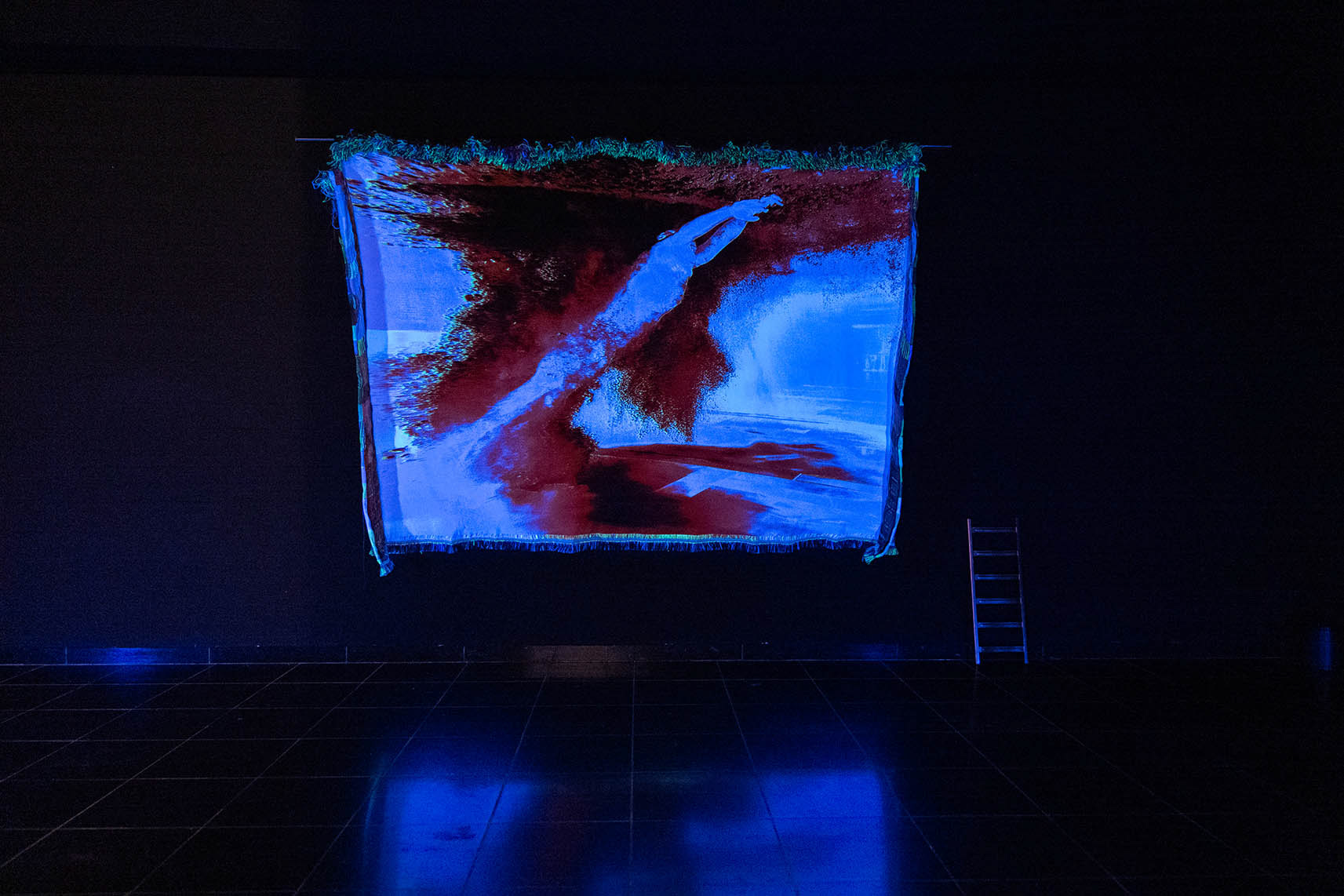
Parallel to the development of the motifs, their support also changes. Photography increasingly leaves classical fine-art paper and migrates onto other materials, particularly glass, textile and garments. The image itself begins to become an object.
Glass possesses a particular quality. It is hard and at the same time fragile. It can protect and shatter in the next moment. Through its transparency, photography also becomes permeable. Light, wall and architecture become part of the image.
At the same time, a loose connection emerges to historical church windows, in which glass, color, light and religious narrative come together. In a sense, the knight figure thus returns to a historical image support, though without its original promise of salvation.
FLOWERBOY 01–04
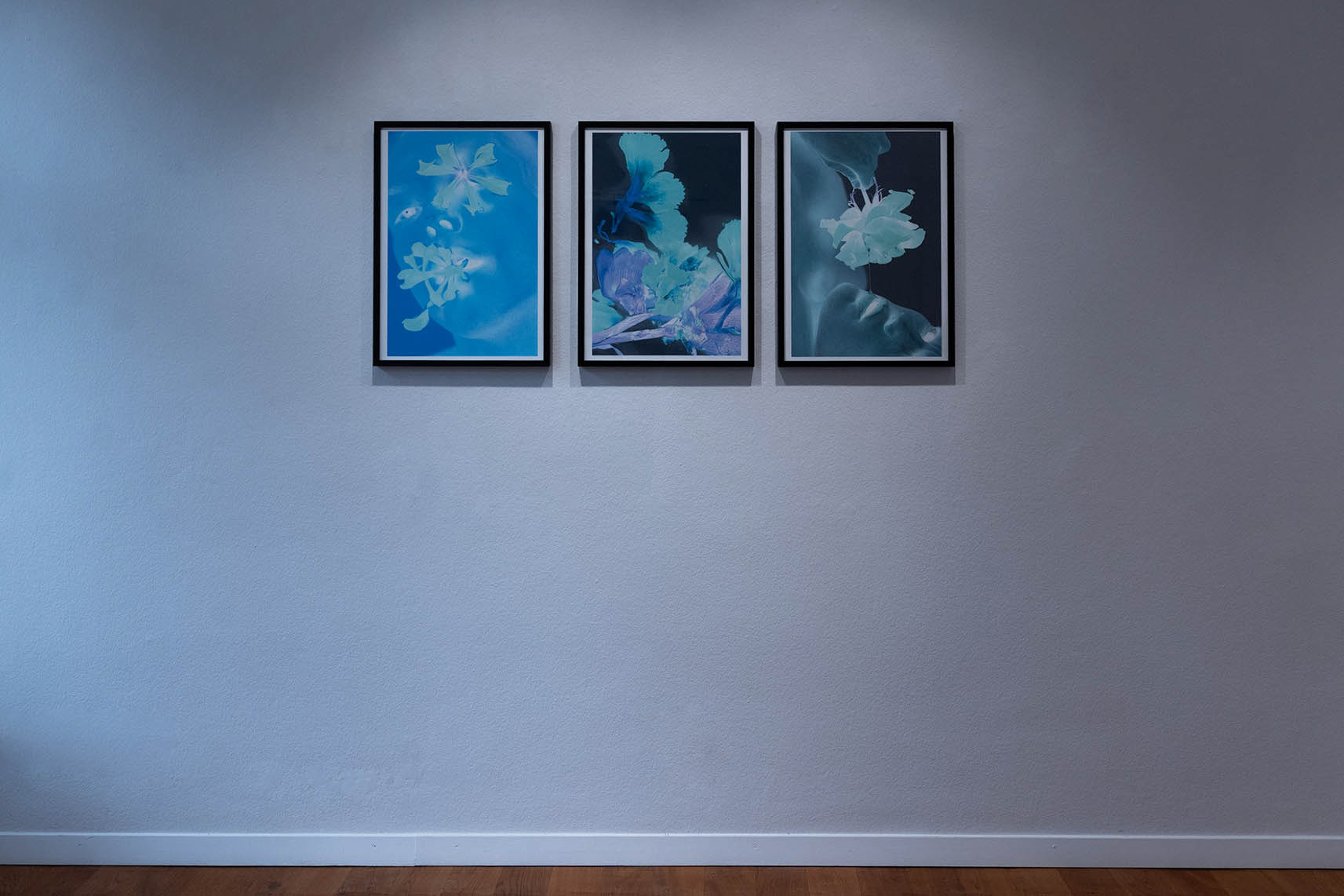
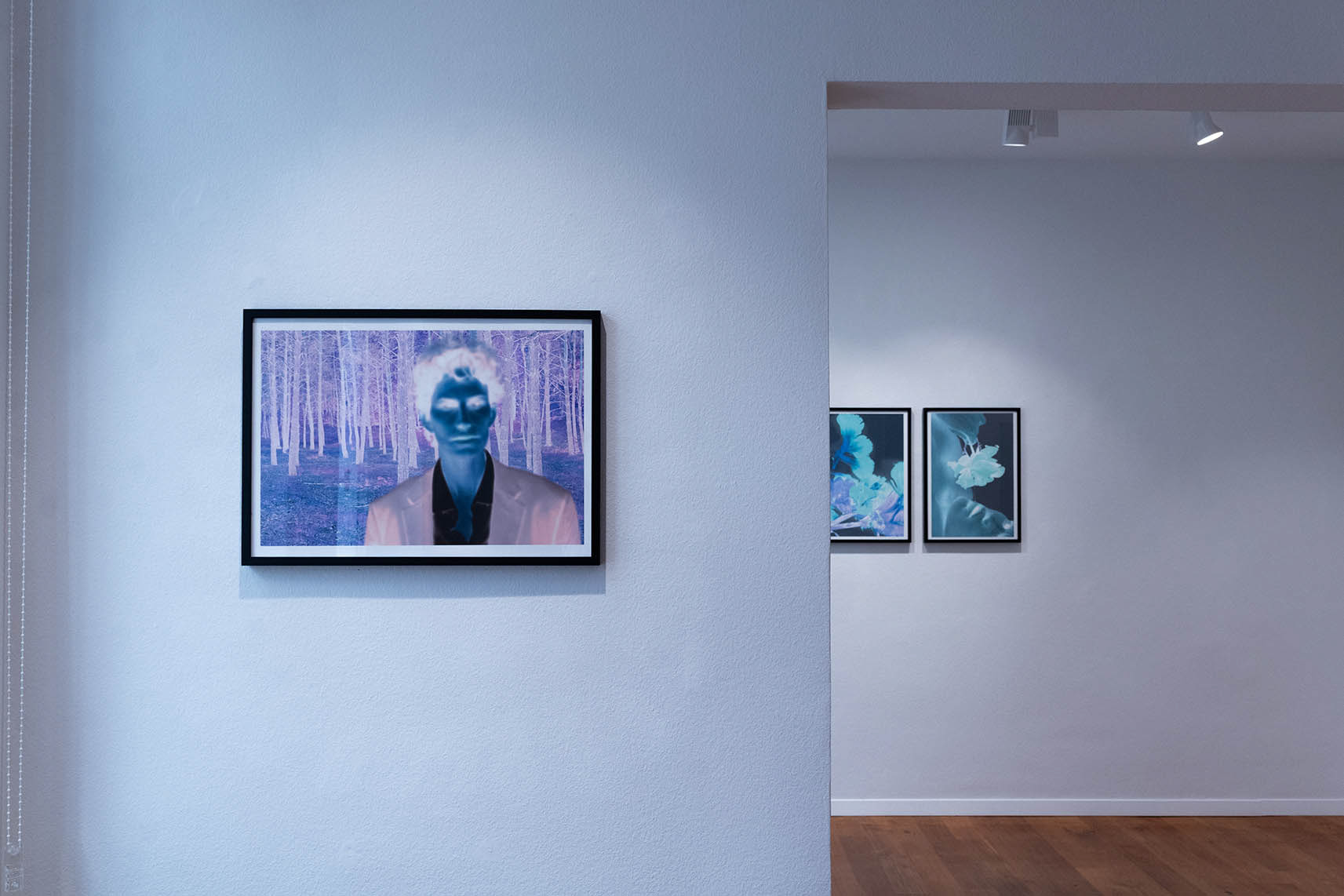
“Flowerboy” shifts the exploration from the armored body to the immediate encounter between human being and plant. At the center of the triptych “Flowerboy 01–03” is an image whose source material is initially barely recognizable: blossoms and plant remnants that had fallen to the floor during the photographic process and been trampled on the photographic cardboard. What was actually residue, waste or the endpoint of an image becomes the motif itself. Through subsequent editing, the destroyed flowers experience a kind of rebirth. Destruction becomes the starting point of a new image.
In the two adjacent photographs, human and flower encounter one another directly. A face turned upside down spits into a blossom. Through the 180-degree rotation, however, the entire physical logic of the image changes. Liquid, mouth and plant suddenly recall a dripstone cave, stalactites and stalagmites. It remains open what is falling and what is growing.
In the other image, blossoms lie across a face. They become ornament, mask, foreign body and extension of the body at the same time.
“Flowerboy 04” finally shows the figure in an almost quiet moment. He approaches a calyx and smells it. Yet precisely this tenderness contains a power relationship. The human being can cut, break, pick or kill the flower. At the same time, he seeks its proximity because it is beautiful, sensitive and transient. Strength and fragility are therefore no longer clearly distributed. Who is actually stronger here?
A loose atmospheric reference is Roy Batty from Ridley Scott’s “Blade Runner”, a physically superior artificial figure who, precisely at the moment of his own finitude, shows empathy and saves Deckard’s life. There, too, strength shifts from physical superiority into something else.
Formally, the photographs are removed from familiar reality through color inversion. Skin, flowers and backgrounds shift into cyan, turquoise, blue and violet. The aesthetic recalls negative and positive processes in analog photography without actually imitating them. For me, this color world also carries a personal memory of my early years of study and of working in the darkroom, with both black-and-white and color prints. The inversion is therefore not merely an effect. It does to the image what the work also attempts conceptually: it reverses relationships. What has been trampled begins to bloom again.
FLOWERS
The real flowers within the exhibition extend the plant world of “Flowerboy” into the space. They are not floral decoration, but function as living attributes, much like shield, helmet or coat of arms within a historical visual language. Their selection follows medieval and Christian fields of meaning. Lily, rose, iris and violet appear at different points in the exhibition and connect the spaces on a second, organic level.
The white Madonna lily, Lilium candidum, was one of the important garden flowers of the European Middle Ages. In Christian imagery it stands for purity, Mary and paradise and appears particularly often in Annunciation iconography. Within “ALLEZ GUT”, it thus directly encounters the world of the knight. Armor and blossom, hardness and fragility, violence and purity, crusade and faith suddenly stand side by side. At the same time, the lily leads to the figure of the Archangel Gabriel and thus to that connection between faith, angel and armed protective figure that runs through several works.
The rose, too, is one of the central flowers of the medieval visual world. The white rose refers to purity and Mary, the red to love, Passion and the blood of Christ. For the exhibition, I am particularly interested in an almost bodily reading. A blossom can appear like a wound. The rose is beautiful because it is open, and precisely in this it can also recall injury. Beauty and wound lie very close together.
The iris leads more strongly into the world of heraldry. Through its formal proximity to the fleur-de-lis, a connection emerges to coats of arms, royalty, knighthood and crusade. The historical fleur-de-lis is not a botanically unambiguous representation of a particular plant, but a stylized sign. This is precisely why I like the idea of mentally translating this sign back into nature. The coat of arms becomes a plant again.
The sweet violet, by contrast, forms an almost complete counter-image to the monumental knight. The knight traditionally stands upright, armed and dominant; the violet grows small and close to the ground. In medieval symbolism it was therefore associated with humility. In the immediate vicinity of a kneeling or lying “Broken Knight”, this small plant becomes a quiet counterpart. It does not comment on the figure. It accompanies it.
The decisive difference between the flowers and almost all other works in the exhibition is that they live and die. Their aging is part of the work. Blossoms open, lose their tension, change color, dry out and eventually fall to the ground. This creates a second temporality within the exhibition. Photographs and sculptures largely preserve their condition; the plants change from day to day.
Wilting is not the destruction of the work, but its continuation. Fallen blossoms, leaves and dried plants are collected and can in turn become material for new works. In this way, the circle closes back to “Flowerboy”. What dies does not have to disappear. It can become the beginning of the next image.
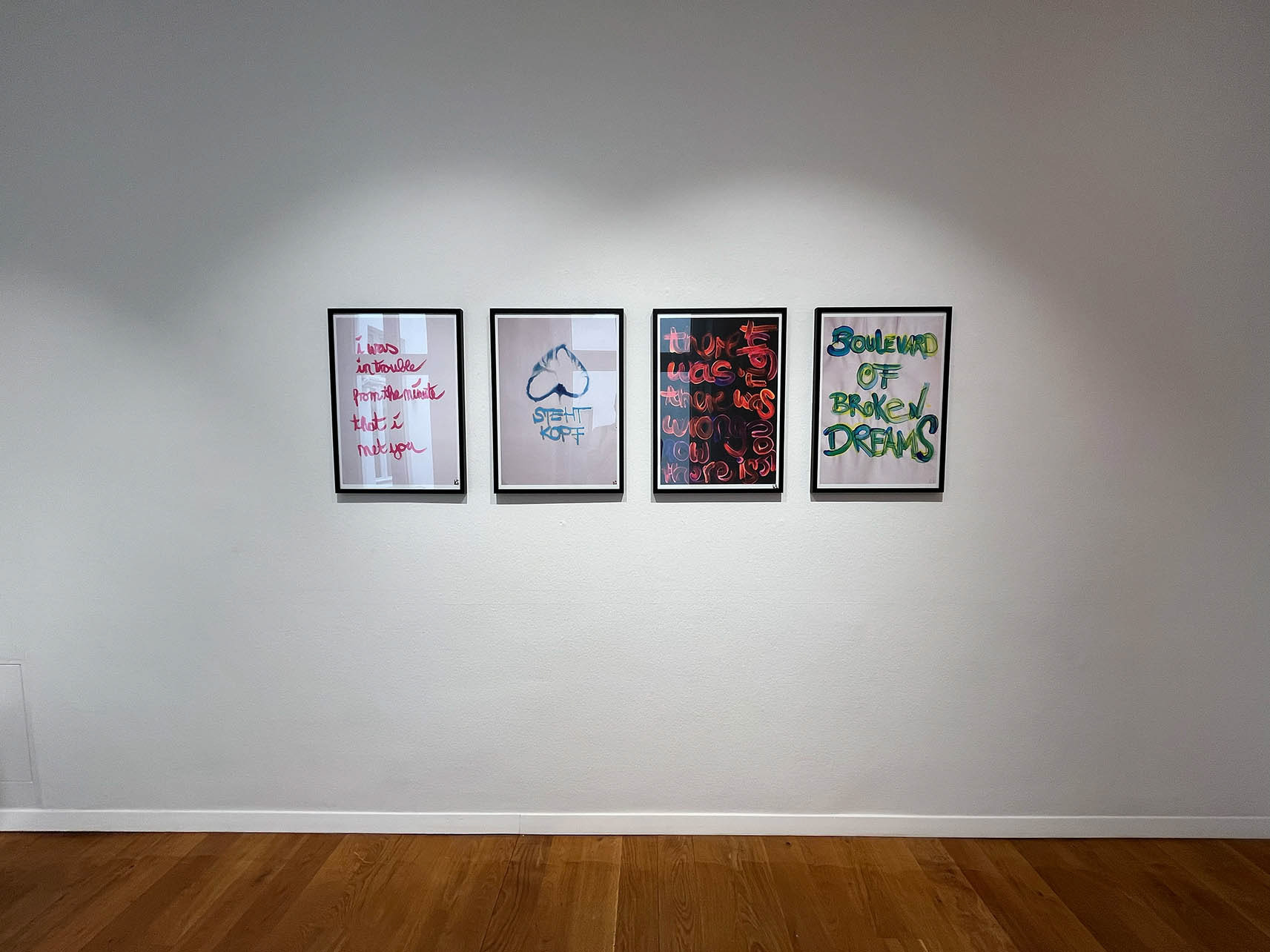
TYPO PAINTINGS
The “Typo Paintings” emerged from a need that is almost opposed to controlled photographic work. For me, photography often means form, placement, composition, light and a fairly clear idea of what is meant to emerge. At some point, the desire arose to relinquish this control, at least temporarily.
Almost intuitively, a second, more open way of working developed from this. Texts meet cardboard and paper, lines meet colors, sentences arise from the moment and do not first have to pass through a long conceptual examination. “Just because.” But of course there is usually more in them.
The texts are snapshots of thought. Observations, wishes, fears, small wounds, political thoughts, personal sentences, pop culture or something encountered on the street.
Sometimes political, sometimes private, sometimes the two cannot be separated at all. Error, chance and intuition are not disruptions of the working process here. They are the working process.
TRUST THE PROCESS
A particular development from this group of works is “TRUST THE PROCESS”. The point of departure is an X-ray image of my child’s teeth. The image shows a strange moment of physical development: the baby teeth have not yet completely fallen out, while the permanent teeth are already visible behind them. Almost like a second row of teeth, like a shark.
What is medically completely normal appears astonishingly radical on closer inspection. A child loses parts of their body. They simply fall out. And new ones grow underneath. This is exactly where the phrase “TRUST THE PROCESS” came from. I kept saying to my child: trust the process. Those things will fall out eventually. The new teeth will find their place. A fairly ordinary reassurance between father and child became a sentence about change, loss of control and trust.
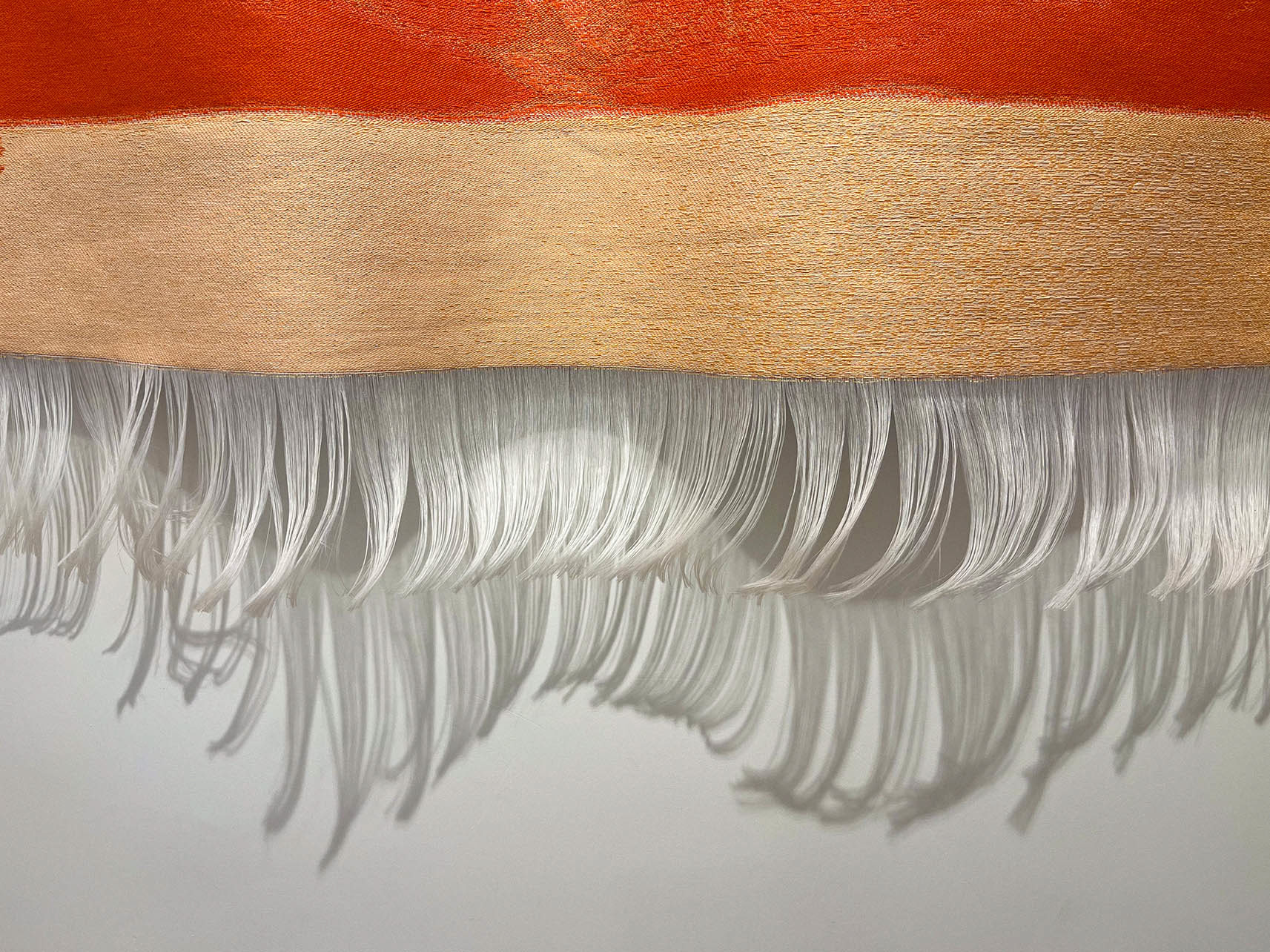
The first paper work still retains something heavy. In black and gray, the X-ray has a medical, bodily and latently morbid quality. Above it stands “TRUST THE PROCESS” in gold. Later, the same motif was translated into a woven tapestry wall hanging, and with that its mood also changes. Black and gray become yellow and orange. Something bright and almost optimistic is set against the morbid heaviness.
The gold is also carried forward materially. Lettering, tooth contours and individual fully filled teeth become part of the fabric in golden thread. The gold no longer lies on top of the image. It is woven into the image.
In this way, the work itself performs the process it describes. The cold medical image becomes a soft textile. Darkness becomes light. Heaviness becomes lightness. The old has not yet completely disappeared while the new is already visible. Perhaps that is the most interesting state of all. You do not yet know how it will turn out. But you can already see that something is changing. Trust the process.
HIMMEL / HADES
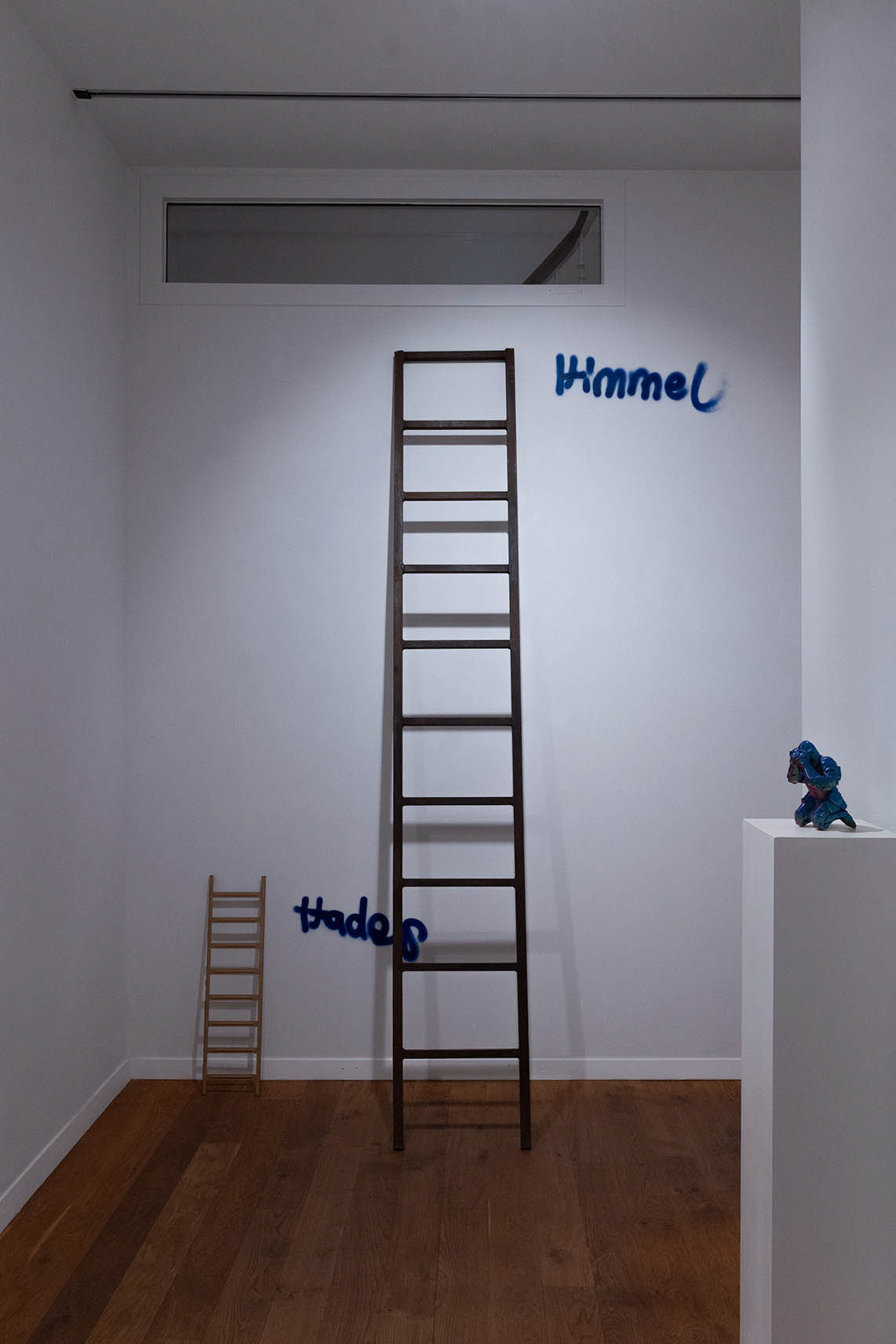
“Himmel / Hades” extends through different rooms and across two floors of the exhibition. At its center is a large, heavy cast-iron ladder. It is rusted, massive and physically present. Beside or above it, “Himmel” is written in graffiti. The way upward is long, heavy and arduous.
Opposite it stands a considerably smaller ladder made from a light metal alloy. It is gilded. Beside it stands “Hades”. The way down is short and it gleams. The reversal is deliberately simple. It is not heaven that appears precious, but the path into the underworld. Gold becomes
the promise of a shortcut, attractive, light and seemingly attainable without much effort.
While there is only one ladder to heaven, the Hades ladder appears several times. Three small golden ladders are distributed throughout the rooms. This, too, contains an experience: the difficult path may confront you once; the easy exits return again and again.
The installation does not assert a religious morality. Himmel and Hades function instead as archetypal directions. Above and below, effort and temptation, decision and consequence become images of human action. Through their repetition, the ladders also take on a spatial function. They seem to communicate with one another across the architecture and connect groups of works that are physically separated. One ladder points to the next. In this way, an imaginary coordinate system emerges within the exhibition.
None of the ladders actually leads anywhere. The movement takes place in the mind. Heaven is far away, heavy and rusty. The path into Hades is short and gleams gold.
DER WEG / IN PLAIN SIGHT / YOUR BODY IS A BATTLEGROUND /
STICK TO YOUR GUTS / DEGAH CHECKST DU
This cycle of works developed in parallel with the film production “Der Weg” with Yaneq and Saralisa Volm for Grzegorzki Records. The woven tapestry “In Plain Sight”, among other works, emerged from the same context. The film is also important to the dramaturgy of “ALLEZ GUT” because the idea of the hero’s journey appears explicitly here and is simultaneously undermined.
There is departure, trial and transformation, but no classical resolution. The protagonist remains a seeker, projection surface and medium. Religious, political and pop-cultural images overlap; meaning remains fluid. The film refuses the authority of an unequivocal narrative and leaves the viewer with the task of making connections themselves.
At the end, there is no longer a single heroine. The figure arrives alone and leaves with others. Nature, community and solidarity do not form a finished utopia, but perhaps a direction. The way out could simultaneously be the way toward something new. In this way, this complex of works connects to the movement of the exhibition: it is not victory that ends the journey, but the decision of how to move forward after the rupture.